A restaurant menu is one of the hardest-working printed pieces in the building. It gets picked up, folded back, set down on wet tables, wiped with sanitizer, and handled by hundreds of hands a week. The design gets all the attention, but the stock underneath it decides whether the menu still looks sharp in three months or curls and smudges in three weeks. Choosing menu paper is really three decisions stacked together: weight, finish, and whether the sheet needs to be waterproof at all.
Paper weight is measured two different ways
The most confusing part of specifying menu paper is that the pound number on a stock does not mean what most people assume. Paper is sold in two families. Text weight is thinner and more flexible, the kind of stock used for flyers, multi-page menus, and inserts. Cover weight, or cardstock, is heavier and rigid, the kind you want for a single-panel dine-in menu that has to stand up to constant handling. The catch is that an 80 lb text sheet and an 80 lb cover sheet are nothing alike, because each family weighs a different base sheet size. That is why the grams-per-square-meter (gsm) figure is the only number that compares stocks honestly.
In gsm terms, 70 lb text lands around 104 gsm, 80 lb text around 118 gsm, and 100 lb text around 148 gsm. Move to cover stock and the numbers jump: 80 lb cover is roughly 216 gsm, 100 lb cover about 270 gsm, and 120 lb cover around 324 gsm. The chart below shows why the pound label misleads and gsm does not.
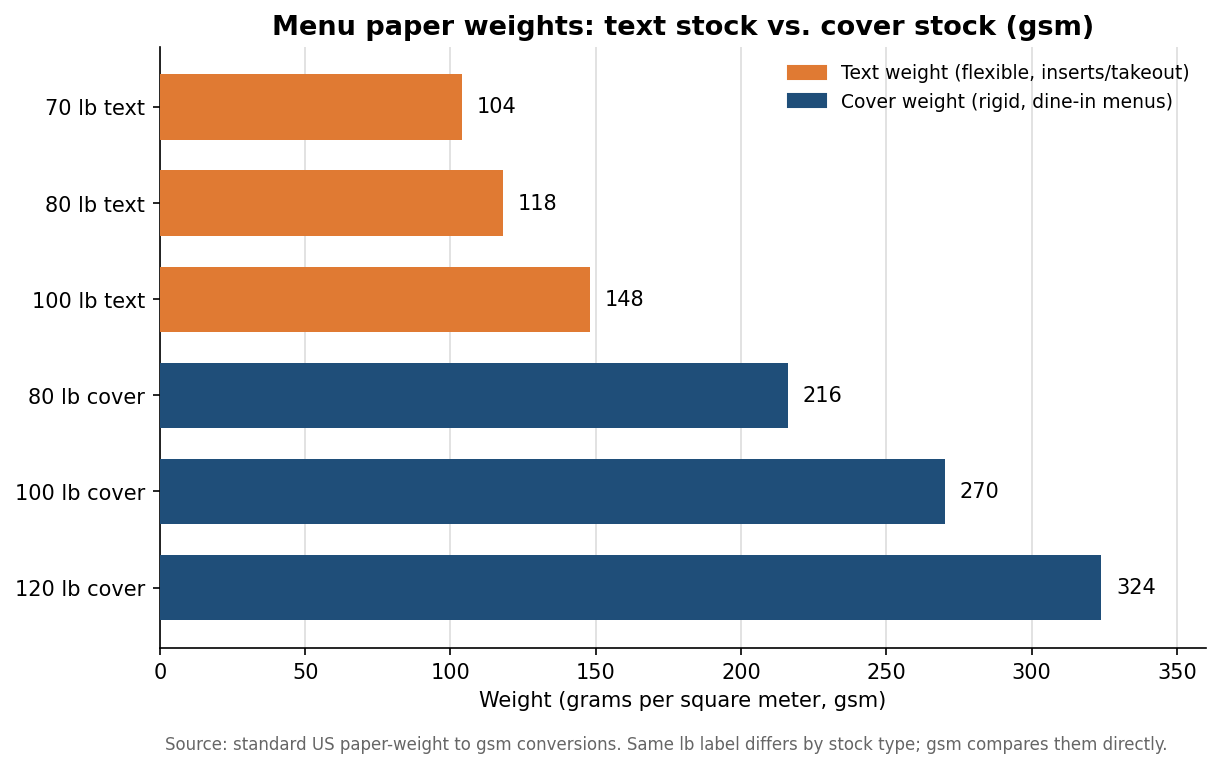
For a working dine-in menu, 100 lb cover, about 270 gsm, is the common sweet spot: heavy enough to feel substantial and resist curling, light enough to print and fold cleanly. Drop to 80 lb text for takeout sheets you expect to hand out and never see again, and reach for 120 lb cover when you want a premium, board-like feel in the hand.
Match the stock to how the menu is actually used
Before choosing a finish, be honest about the menu’s job. A single-use takeout or delivery menu does not need to survive anything, so a 70 to 80 lb text sheet printed cheaply and in bulk is the right call, because it will be recycled within a day. A daily-specials insert that changes every service wants light cover stock so it feels intentional but can be reprinted without guilt. A reusable dine-in menu handled at every table is the one that justifies spending on weight and protection, because the cost of a tired, stained menu is paid in guest impression, not in paper.
Getting this match right also prevents overspending. Laminating a takeout menu is wasted money, and printing a high-touch dinner menu on bare text stock is a false economy that shows up as dog-eared corners within a month. Decide the use first, then let it dictate the spec.
Coatings and lamination: protection with trade-offs
A coating changes both look and durability. Aqueous and UV coatings are applied during printing and add a thin protective layer; a matte coating keeps a clean, low-glare surface while a gloss or UV coat deepens color and adds sheen. Coatings resist fingerprints and light moisture, but they do not make a menu waterproof.
Lamination is a separate plastic film bonded to both sides after printing, and it comes in thicknesses measured in mils. 1.5 mil is light and flexible, 3 mil is the common menu default, 5 mil is rigid and heavy-duty, and 10 mil is nearly board-stiff. Lamination genuinely waterproofs the surface and lets staff wipe a menu down between seatings, which is its main appeal. Its weakness is the seam: because it is a film bonded to paper, the edges can eventually separate, and in humid or heavily cleaned environments the layers can cloud, bubble, or delaminate. A laminated menu also cannot be folded without cracking along the fold line, so laminated menus are almost always flat single panels.
When synthetic waterproof stock earns its price
Synthetic papers such as Teslin, Yupo, and Polyart solve the delamination problem by removing the layers entirely. Instead of paper wrapped in plastic, the sheet is a single waterproof, tear-resistant material, so the water and tear resistance run all the way through rather than sitting on the surface. There is nothing to peel, and the menu can be scrubbed and sanitized repeatedly without clouding. Synthetic stock is sold by mil thickness that maps loosely to cover weight: roughly 5 mil behaves like a light 24 lb bond, 8 mil like an 80 lb cover, 10 mil like a 120 lb cover, and 14 mil like a rigid 180 lb cover that may need a commercial press to run.
The trade-off is cost. Synthetic sheets cost more per unit up front than coated cardstock or lamination. The case for them is cost per use, not cost per sheet: a menu that survives a year of daily service and cleaning can work out cheaper over its life than cardstock reprinted every few weeks. The chart below sketches that trade-off, roughly what higher stock cost buys in service life. Treat the numbers as indicative ranges rather than quotes; real figures move with quantity, handling, and how aggressively menus get cleaned.
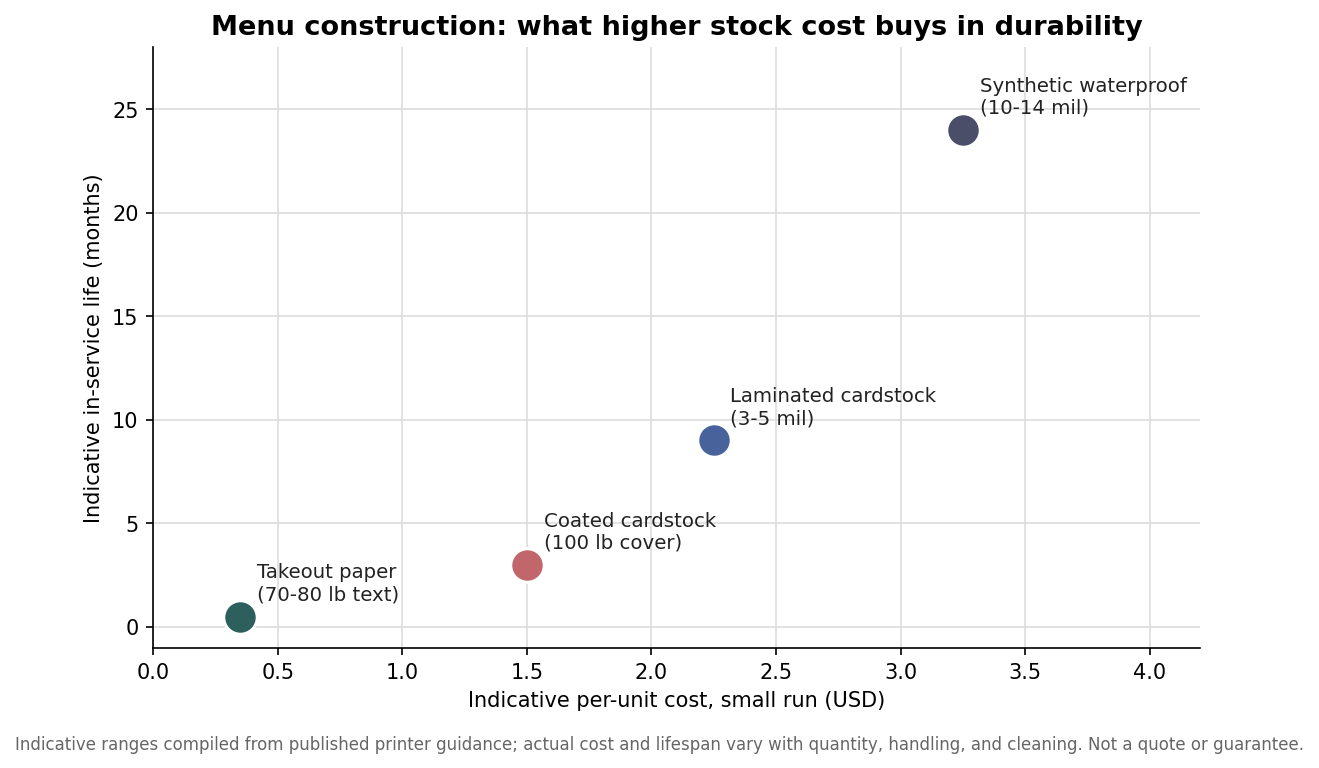
As a rule of thumb, high-turnover, high-touch operations, and anything sanitized between every seating, tend to come out ahead on synthetic stock, while a menu that changes seasonally may never live long enough to justify it. When in doubt, order a small test batch on the stock you are considering and put it through a week of real service before committing to a full run.
Sizes, folds, and lead times
Menu dimensions are more standardized than they look. The workhorse sizes are 8.5 by 11 inches (letter), 8.5 by 14 inches (legal, for longer menus), and 11 by 17 inches folded down to a 8.5 by 11 bi-fold. Narrow formats such as 4.25 by 11 inches suit bar and drink lists, and small 5.5 by 8.5 inch cards work for dessert or daily specials. Folding options like half-fold, tri-fold, and Z-fold expand panel count without adding sheets, but remember that lamination and folds do not mix.
On timing, straightforward menu runs typically print in about 3 to 4 business days after proof approval, with rush options available at most printers; design and proofing add time on top of that, so build in a few extra days if the artwork is not print-ready. On cost, small runs of coated cardstock menus commonly land in the low single dollars per piece, and one national printer lists 50 menus at around $1.78 each, with the per-unit price dropping toward pennies at bulk quantities in the thousands. Laminated and synthetic menus carry a higher per-piece price for the durability they add. Those are indicative bands to plan around, not firm quotes; the real number depends on size, stock, coating, and quantity. The short version is simple: pick weight by how much handling the menu will take, pick a finish by how wet and how often it gets cleaned, and only pay for synthetic stock when the menu will live long enough to earn it back.